
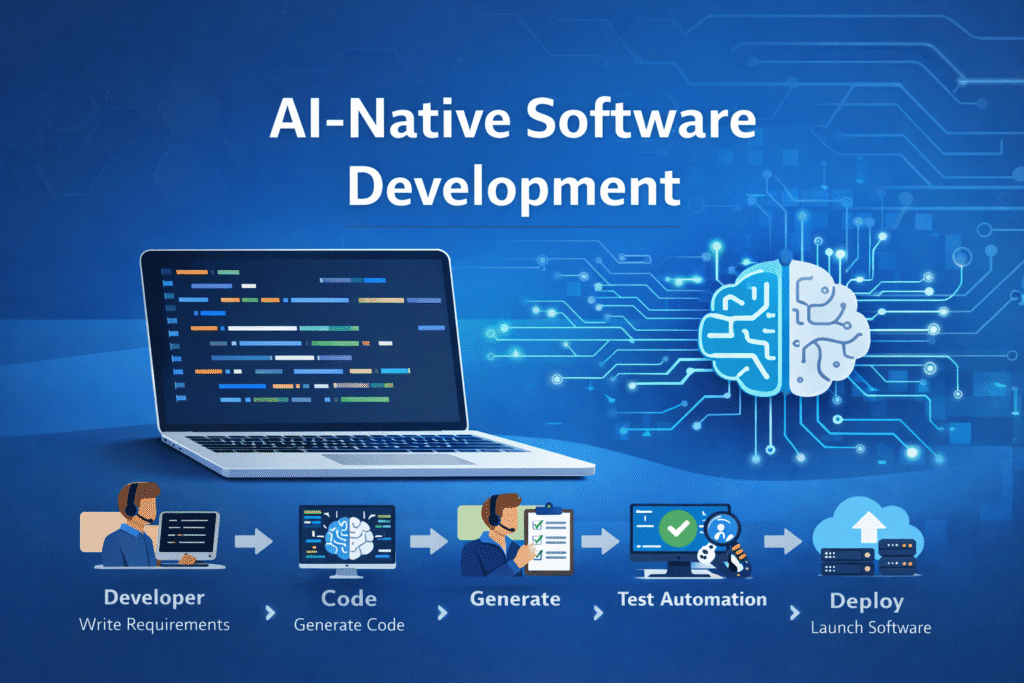
AI-Native Software Development: How AI Is Transforming Programming
Software development is changing faster than at any point in the history of computing.
For decades, programmers manually wrote most of the logic behind applications, systems, and platforms. Development tools improved productivity through better compilers, frameworks, and automation pipelines, but the core activity of coding remained largely manual.
Artificial intelligence is now reshaping that process.
Modern development environments increasingly include AI systems that assist engineers in writing code, detecting bugs, generating tests, and even designing software architectures.
This approach is often described as AI-native software development.
Instead of viewing AI as a feature inside an application, organizations are embedding AI directly into the software development lifecycle itself.
Developers collaborate with AI systems that analyze large codebases, understand programming patterns, and provide real time suggestions. The result is faster development cycles, higher code quality, and more efficient engineering teams.
This article explores how AI-native development works, the technologies behind it, practical use cases, benefits, risks, and how organizations can adopt this model successfully.
The Evolution of Software Development
To understand why AI-native development matters, it helps to examine how software engineering has evolved.
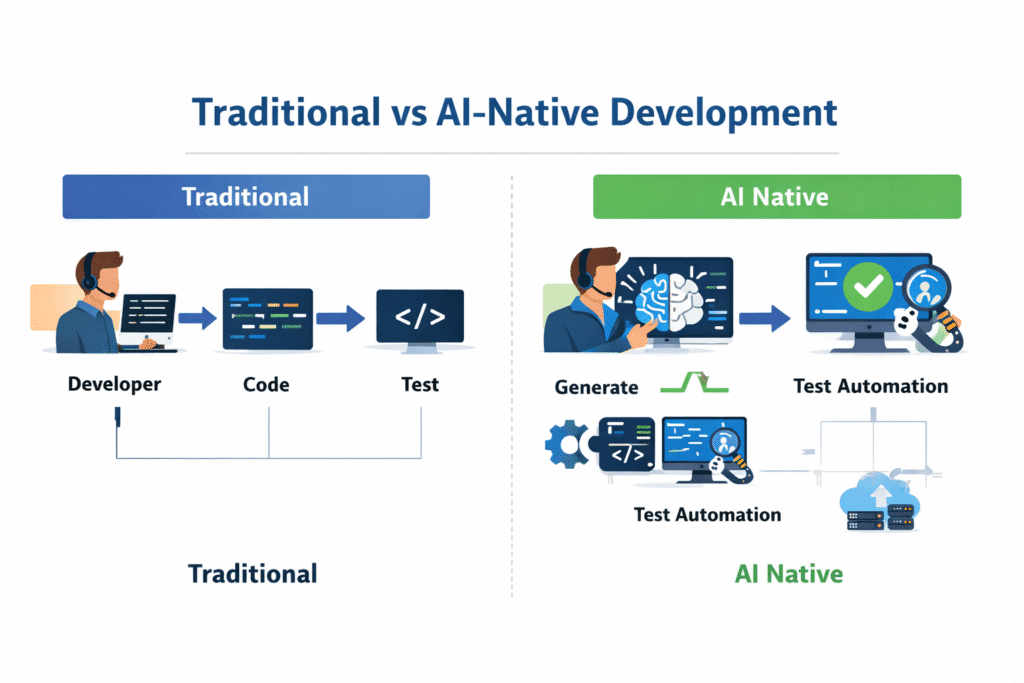
Figure: Traditional vs AI-Native Development Workflow
Manual Programming Era
Early software development required engineers to manually write almost every line of code.
Development involved:
Writing business logic
Debugging errors
Designing system architecture
Documenting code
Testing functionality
This process was slow and required large engineering teams to maintain complex systems.
Applications often took years to develop and deploy.
DevOps and Automation Era
The next major shift came with DevOps and automation tools.
Organizations introduced systems that automated parts of the development lifecycle, including:
Continuous integration pipelines
Automated testing frameworks
Infrastructure as code
Containerized deployments
These improvements reduced deployment time and increased reliability.
However developers still wrote most of the code manually.
AI Assisted Development Era
Today the industry is entering the AI assisted development era.
Developers now work alongside AI systems that help them generate and improve code.
For example, developers can describe a function in plain English and receive working code suggestions.
AI tools can also analyze entire repositories to detect performance issues, bugs, and security vulnerabilities.
This transformation is fundamentally changing how software is built.
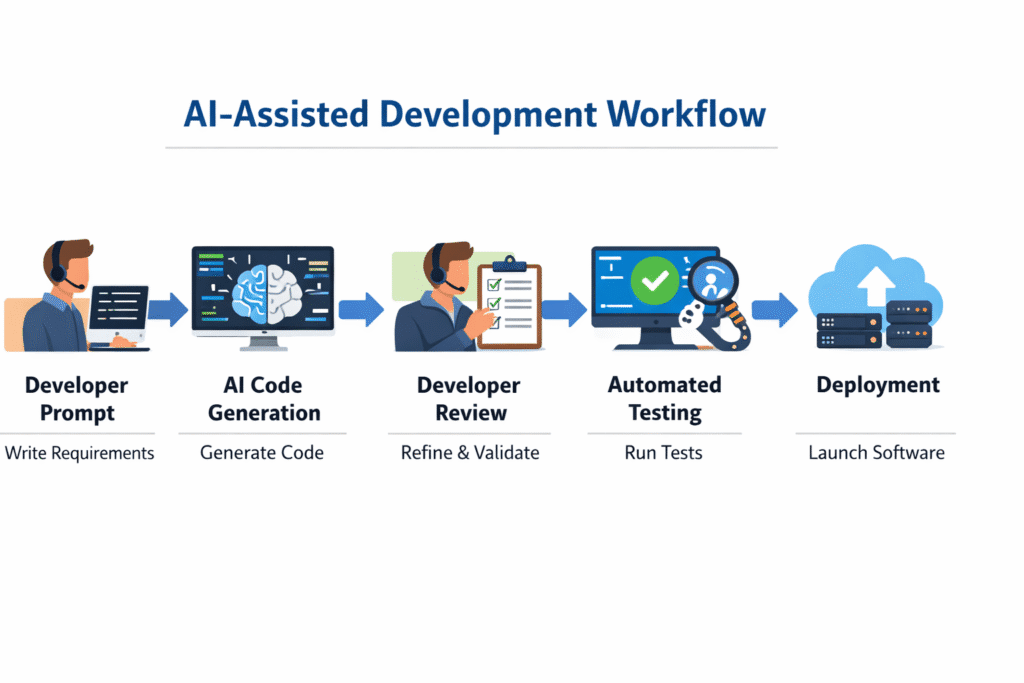
Figure: AI Assisted Development Workflow
What Is AI-Native Software Development
AI-native development is an approach where artificial intelligence tools are embedded directly into the development workflow.
Instead of performing every task manually, developers collaborate with intelligent systems that assist with coding, testing, and optimization.
Typical AI-assisted development activities include:
Generating code from natural language prompts
Automatically creating unit tests
Identifying bugs or inefficiencies
Producing documentation
Refactoring legacy code
The developer remains responsible for system design, architecture, and validation.
AI simply accelerates repetitive and analytical tasks.
This creates a human plus AI engineering model.
Core Technologies Enabling AI-Native Development
Several technological advancements have made AI-assisted development possible.
Large Language Models for Programming
Large language models trained on massive datasets of source code and documentation can understand programming languages and development patterns.
These models can perform tasks such as:
Generating functions
Explaining code logic
Translating code between languages
Creating documentation
They work by learning statistical patterns across millions of software repositories.
AI Coding Assistants
AI coding assistants integrate directly with developer tools such as Visual Studio Code or JetBrains IDEs.
They provide features such as:
Real time code suggestions
Auto completion for complex functions
Refactoring recommendations
Debugging assistance
These tools allow developers to focus more on system design and less on repetitive coding tasks.
Machine Learning Code Analysis
Machine learning models can analyze codebases to detect structural issues and vulnerabilities.
Examples include:
Security vulnerability detection
Code complexity analysis
Performance optimization recommendations
Dependency risk analysis
This helps engineering teams maintain high code quality even in large systems.
Automated Testing Systems
Testing is often one of the most time consuming stages of development.
AI systems can generate tests automatically by analyzing application behavior.
Benefits include:
Higher test coverage
Faster QA cycles
Detection of edge cases
Popular AI Developer Tools
Many companies already use AI development tools in production environments.
Examples include:
AI Coding Assistants
GitHub Copilot
Amazon CodeWhisperer
Tabnine
These tools generate code suggestions while developers write code.
AI Testing Tools
Diffblue
Testim
Mabl
These platforms generate and maintain automated test cases.
AI Security Tools
Snyk
DeepCode
CodeQL
They analyze code repositories to detect security vulnerabilities.
Benefits of AI-Native Development
Organizations adopting AI-assisted development see several measurable benefits.
Faster Development
AI tools significantly reduce development time.
For example, generating an API endpoint that once required hours of coding can now take minutes.
Higher Code Quality
AI systems continuously analyze code and suggest improvements.
Benefits include:
Fewer production bugs
Better coding standards
Improved maintainability
Increased Developer Productivity
Developers spend less time on repetitive work such as writing boilerplate code or debugging simple issues.
Instead they focus on solving business problems and designing systems.
Faster Onboarding
AI tools help new developers understand unfamiliar codebases.
Developers can ask AI systems to explain code or architecture instantly.
Real World Use Cases
Enterprise Software
Large companies use AI tools to maintain complex codebases.
Applications include:
Legacy code modernization
Automated documentation
Code review assistance
Startup Development
Startups benefit from faster product development.
Small teams can build complex platforms using AI tools.
API Development
AI can generate API endpoints, database models, and integration tests automatically.
This significantly speeds up backend development.
Data and Analytics Platforms
AI tools can assist in building data pipelines and analytics systems.
Developers can generate SQL queries, transformation scripts, and dashboards using AI.
Risks and Challenges
Despite its advantages, AI-native development also introduces risks.
Code Reliability
AI generated code may contain hidden bugs or inefficient logic.
Developers must review all AI generated outputs.
Security Issues
AI tools sometimes generate insecure code patterns.
Security testing and vulnerability scanning remain essential.
Intellectual Property Concerns
Some AI models are trained on public repositories, which may raise licensing questions.
Organizations must review generated code carefully.
Over Reliance on AI
Developers should maintain strong programming fundamentals.
AI should assist developers rather than replace their expertise.
Best Practices for Adopting AI Development
Organizations should adopt AI tools gradually.
Recommended approach:
1 Introduce AI coding assistants
2 Integrate AI testing tools
3 Maintain strong code review processes
4 Train developers to use AI tools effectively
Metrics for Measuring AI Development Success
Organizations should track metrics to evaluate AI adoption.
Key metrics include:
Development cycle time
Code defect rate
Deployment frequency
Test coverage
Developer productivity
Example formula:
Productivity Increase = (New Output − Baseline Output) / Baseline Output
These metrics help determine whether AI tools are improving engineering performance.
The Future of AI-Native Development
Several trends are likely to shape the future of software engineering.
Autonomous Development Agents
Future AI systems may build entire applications based on high level instructions.
Developers will guide these systems rather than writing most code manually.
AI Assisted Architecture
AI tools may soon help engineers design scalable architectures.
They could simulate performance, cost, and scalability before deployment.
Multi Agent Development Systems
Multiple specialized AI agents may collaborate on projects.
Examples include:
Coding agent
Testing agent
Security agent
Deployment agent
Together they could automate large portions of the software lifecycle.
Conclusion
AI-native software development represents a major transformation in programming.
Artificial intelligence is changing how developers write, test, and deploy software.
Rather than replacing developers, AI tools act as powerful collaborators that improve productivity and code quality.
Organizations that successfully combine human expertise with intelligent automation will lead the next generation of software innovation.
The future of software engineering is not fully automated.
It is human developers working alongside intelligent systems to build better software faster.